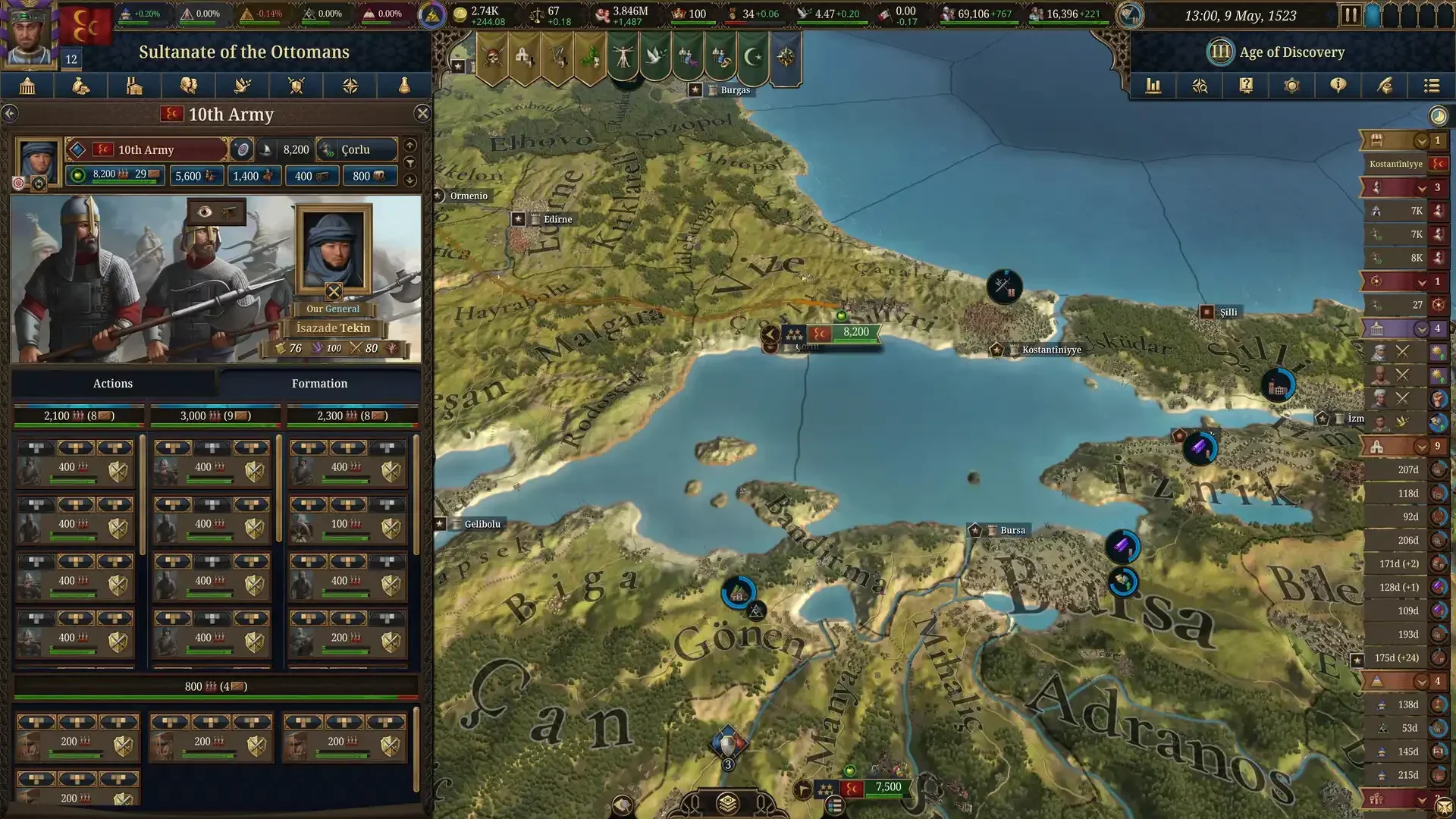
Look, I’ve spent way too many hours staring at the EU5 map, plotting my next move, wondering if I should push for that Rome formation or settle for something easier. And every single time, I found myself bouncing between three different wikis trying to figure out what the hell I actually needed to form my dream nation. So here’s the thing—I’m done with that nonsense, and you should be too.
This is your complete EU5 all formable nations list, and I mean complete. We’re talking 114 nations spanning every corner of the globe, from the historical powerhouses like the Roman Empire to the fantasy fever dreams that make your friends question your life choices. Whether you’re chasing achievements, painting the map in your favorite color, or just want to see what’s possible in this beautiful mess of a grand strategy game, you’ve come to the right place.
 ARC Raiders on Steam Deck: The Complete Settings and Performance Guide
 Table of Contents
What Are Formable Nations in EU5?
Before we dive into the massive list, let me break down what we’re actually talking about here. Formable nations in Europa Universalis 5 are basically alternative identities your country can adopt when you meet specific requirements. Think of them as prestige upgrades—you conquer enough territory, match the right culture or religion, and boom, you get to transform into something bigger and usually more powerful.
Here’s what makes this system interesting: players can form nations of equal or higher tier, but the AI? Those digital rivals can only form higher-tier nations. This means you’ve got way more flexibility to experiment with different formation paths throughout your campaign. And trust me, understanding the government mechanics becomes crucial when you’re planning these transformations.
The game categorizes formable nations into three distinct types, and this is where things get really interesting for achievement hunters and role-players alike:
Historical Nations are the real deal—countries that actually existed during the game’s 1337-1837 timeframe. We’re talking France, Spain, the Ottoman Empire, stuff that would make your history teacher nod approvingly. These are your safest bets if you’re going for achievements since they don’t mess with the game’s historical integrity settings.
Plausible Nations are the “what if” scenarios that could have realistically happened with slightly different circumstances. Think unified Germany before it actually unified, or a resurrected Persian Empire. These nations represent alternate histories that weren’t completely impossible, just improbable. They still feel grounded in reality, which is perfect if you want to bend history without breaking it.
Ahistorical (Fantasy) Nations are where Paradox lets you go absolutely wild. We’re talking about reforming the Roman Empire in 1600, creating a unified Celtic empire, or establishing a North Sea Empire that would make Vikings weep with joy. Here’s the catch though—forming these disables achievements, so you’re trading bragging rights for pure sandbox fun.
The beauty of this system is that you can toggle which types appear in your playthrough. Before starting a new game, just open the Game Rules menu under Flavor settings, and you can enable or disable Historical, Plausible, or Fantasy formables. Want a purely historical experience? Turn off the fantasy stuff. Want to go full alternate history mode? Enable everything and watch the chaos unfold.
 The Rusted Gear Hell Is Back: Here’s Where To Find Them After The Reset
 The Complete EU5 All Formable Nations List
Alright, here’s where we get into the meat of this guide. I’ve organized this list by region because honestly, that’s how you’re going to be thinking about it during your campaigns. When you’re conquering Scandinavia, you don’t want to scroll through Asian nations trying to figure out what you can form next.
For each nation, I’m including the basic requirements because knowing what you need is half the battle. Some of these are straightforward (“control 75% of this region”), while others have weird quirks like estate privilege requirements or specific Situation completions that’ll make you scratch your head.
European Powerhouses: The Classic Formations
Let’s start with Europe because, let’s be honest, this is where most of us spend our time in EU5. These are the formations that shaped real history, and they’re some of the most satisfying to pull off in-game.
Great Britain is one of those iconic formations that feels amazing to complete. You need British culture group and 75% control of the Britain region, but here’s the kicker—the Hundred Years’ War Situation needs to be over first. England, Scotland, and Wales can’t exist independently unless they’re your subjects. It’s Historical tier, so you’re good for achievements, and honestly, the strategic positioning you get makes this worth pursuing every single time.
Speaking of Britain, you can also form England, Scotland, Wales, and even Ireland individually if you’re going for more focused campaigns. Ireland is particularly interesting because you need to be the leader of the High Kingship of Ireland, which adds a whole diplomatic layer to the conquest. Each of these requires 75% control of their respective areas, but the cultural requirements vary—Welsh needs either Welsh culture or Brythonic language, which opens up some creative formation strategies.
Spain requires Iberian culture group, Christian religion, and 75% of Iberia with all locations owned by Christian nations. It’s a crusade formation basically, which makes sense historically. The flip side is Al-‘Andalus, the Muslim version requiring the exact opposite religious setup. Both are tier 3 empires, so you’re looking at serious end-game content here.
France is surprisingly straightforward—French culture group, Paris, and 75% of the France region. Tier 3 Historical, and it’s one of those formations that feels inevitable if you’re playing in Western Europe. The game even has that flavor text about marking “the beginning of an evolutionary period” which is Paradox’s way of saying “centralization time, baby.”
Now let’s talk about the big three that everyone asks about: Germany, the Holy Roman Empire, and the Roman Empire.
Germany is tier 4 Plausible, requiring German culture group and 75% of both Northern and Southern Germany regions. It’s the unified Germany that historically came much later, but in EU5, you can make it happen earlier. Successfully forming it bumps you to Empire rank if you’re not already there.
The Holy Roman Empire is also tier 4 but can only be formed through the Renovatio Imperii policy of the HRE itself. This is basically the “I won EU5” button—same regional requirements as Germany, but you’re explicitly reconstituting the empire of Otto the Great. It’s Plausible tier, which makes sense given how fragmented the HRE actually was throughout this period.
The Roman Empire though? That’s the ultimate fantasy formation. Tier 4 Ahistorical, and it requires either being Byzantium or owning Rome (but not as the Rome tag itself). You need to be a hegemony, Christian or Hellenist religion, and control 75% of a absolutely massive list: Italy, Iberia, France, Balkans, Britain, Anatolia, Southern Germany, the Crescent, Egypt, Maghreb, Carpathia, and the Caucasus. Your court language switches to Latin, your capital moves to Rome, and you officially become the most pretentious player at your multiplayer table. Worth it? Absolutely.
Eastern European Dreams and Steppe Empires
Moving east, we’ve got some seriously cool formation options that don’t get enough love in the community discussions.
Poland and the Commonwealth represent one of the most interesting formation paths in the game. Poland itself requires Polish culture group, four specific areas (Central, Greater, Lesser Poland, and Mazovia), plus Kraków and Warsaw. It’s tier 2 Historical, so very achievable early-to-mid game. The Commonwealth though? That’s tier 3, requires either Polish or Lithuanian culture group, and demands control of a huge swath of Eastern Europe. The best part? Poland and Lithuania either need to not exist or be your subjects—it’s the ultimate diplomatic unification fantasy.
Russia is another massive formation—tier 4 Historical requiring East Slavic culture group, Moscow, Novgorod, and 50% of Russia, Ural, and Pontic Steppe regions. Successfully forming it grants you Empire rank, which historically makes total sense. This is the Tsardom that scared everyone from Sweden to the Ottomans.
Ruthenia is the plausible alternative centered on Kyiv rather than Moscow. It’s tier 3, requires specific Slavic cultures (including Cossack, which is awesome), Kyiv ownership, and 60% of the Ruthenia region. The flavor text is fantastic—basically calling out Moscow as pretenders to the Rus’ legacy. Historical sass at its finest.
For steppe enthusiasts, we’ve got formations like Mongolia (tier 4, ridiculously hard requirements including Sarai, Kazan, Samarkand, and basically conquering half of Asia), the Īlkhānān (tier 4 requiring IO leadership and massive Persian holdings), and Manchu (tier 3 with Jurchen culture and control of Manchurian territories).
Asian Ambitions: From Delhi to Japan
The Asian formable nations often get overlooked, but they’re some of the most rewarding in the game, especially if you’re tired of European politics.
Mughal is the big one everyone knows about. Tier 4 Historical, requires Islam, Iranian or Turkic culture (or Afghani language), and ownership of Delhi, Agra, and Lahore plus 80% of Hindustan. Successfully forming this grants Empire rank and represents the formation of one of history’s wealthiest and most powerful empires. If you haven’t done a Mughal run, you’re missing out.
Delhi itself is tier 3, also requires Islamic rule but with broader culture options (Indian, Iranian, Mongol, or Turkic). It’s the predecessor formation that makes sense if you’re not quite ready for the full Mughal requirements yet.
Hindustan is tier 4 Plausible and represents a unified India—requires 70% of the entire South Asian subcontinent. This is essentially the “I conquered India” achievement, and it’s glorious when you pull it off. The strategic depth required rivals anything in the European theater.
Regional powers include Bengal (tier 3 Historical with 80% of Bengal region), Punjab (tier 3 with Punjabi culture), Rajputana (tier 3 requiring Rajasthani language and 80% of the region), Gujarat (tier 3 Islamic formation), and Deccan and Maratha representing southern Indian power.
In Southeast Asia, you’ve got Malaya, Siam, Banten, and Malacca—each requiring 50-90% regional control with specific cultural and religious requirements. These are fantastic for trade-focused campaigns since you’re controlling some of the most lucrative nodes in the game.
Yamato represents unified Japan, formed through events rather than direct player action, which makes it unique among formable nations. The game has special mechanics for Japanese unification that tie into the broader East Asian political system.
China itself is tier 4 Historical, requiring Chinese culture group, 70% of all four Chinese regions (West, East, North, South), and the creation of the Middle Kingdom international organization. Successfully forming it grants Empire rank and represents achieving what every Chinese dynasty claimed—the Mandate of Heaven.
Middle Eastern Might and African Ambitions
The Middle East and Africa have some absolutely wild formation options that let you reshape the entire region.
Persia is tier 4 Historical, requires Iranian culture group and 50% of the Persia region, granting Empire rank upon formation. This is the resurrection of one of history’s greatest empires, and the Persian culture group is diverse enough to give you multiple starting points.
Arabia is tier 3 Plausible with Arabian culture group and 75% of the Arabia region. It represents a unified Arab state that never quite happened historically but came close several times. The strategic position controlling trade routes between three continents makes this formation incredibly powerful.
Rûm is particularly interesting—tier 4 Historical requiring Turkic culture, Islam, and 85% of Anatolia. Here’s the quirk: you need to emerge victorious from the Rise of the Turks Situation without becoming the Ottomans. It’s an alternative history where the Sultanate of Rum survives and thrives instead of fragmenting.
Egypt requires not being the Mamluk Sultanate and controlling 75% of the Egypt region. Tier 3 Historical, and historically accurate since Egypt eventually did form its own identity separate from various conquering empires. The regional bonuses make this worth pursuing if you’re playing in North Africa.
In Sub-Saharan Africa, we’ve got Sokoto (tier 3 Hausa culture Islamic state), Ethiopia (tier 3 requiring Coptic faith and specific highland cultures), Kongo (tier 3 Bantu religion formation), and various regional powers like Mossi, Beja, and Mali.
Mali deserves special mention because successfully forming it grants Empire rank. It requires Mande language, Niani control, and the Mali and Ghana areas. This represents the resurrection of Mansa Musa’s legendary empire, and pulling it off feels absolutely epic.
New World Nations and Colonies
The Americas have their own unique formable nations that represent both indigenous consolidation and colonial ambitions.
The United States is tier 4 Historical, requires British culture (but not Native American), and 35% of the East Coast region. The flavor text is pure revolutionary fervor: “Give us liberty, or give us death!” It’s a late-game formation that represents colonial rebellion, though in EU5’s timeline you’re forming it potentially decades before 1776.
Canada is tier 3 Plausible with similar requirements but focused on the Canada region. It can be formed by either British or French culture groups, reflecting the historical colonial situation.
Mexico is tier 3 Historical and can be formed either by Iberian culture groups OR Native American cultures with Christian religion and 50% of Mesoamerica. This dual-path formation represents both Spanish colonial consolidation and potential indigenous resistance narratives.
For indigenous formations, Inca (Tawantinsuyu) is tier 3 requiring Quechuan language and control of Acamama and Puna areas, granting Empire rank. Maya is tier 2 Plausible with Maya language or Mayan religion. Haudenosaunee represents the Iroquois Confederacy with tier 3 requirements. Pueblo is tier 2 requiring specific southwestern cultures.
These formations are particularly interesting because they represent what could have been if indigenous nations had unified before European contact or managed to resist colonization more effectively.
Fantasy Tier: Let Your Map Painting Dreams Run Wild
Now we’re getting to the fun stuff—the formations that make historians cry and min-maxers salivate.
Europa is tier 5 Ahistorical and represents ultimate continental domination—50% of the entire European continent with more than 1,500 locations. This is basically the EU5 victory lap formation. You’ve conquered everything, you’re unstoppable, and you want everyone to know it.
North Sea Empire is tier 4 Ahistorical, requiring British or Scandinavian culture group and 50% of Britain, Ireland, Scandinavia, and North Atlantic Islands. This represents Cnut the Great’s empire on steroids, stretching across the northern waters.
Celtica is tier 3 Ahistorical with Celtic culture group, Brythonic or Gaelic court language, and the Celtic Traditions government reform. It requires Ireland, Wales, Lowlands, Highlands, Hebrides, Brittany, and Cornwall. It’s the unified Celtic empire that never existed but absolutely should have according to every fantasy novel ever written.
Carthage is tier 2 Ahistorical and represents the ultimate “screw you” to Roman history. You need Tunis, areas around Tunisia and Sicily, and the game literally positions you as “the Heirs of Carthage” rising to challenge Roman pretenders. Your capital moves to Tunis and gets renamed to Qart-ḥadašt. It’s gloriously petty and I love it.
Baltic is tier 2 Ahistorical requiring Baltic culture group and massive territorial holdings across the Baltic region. It’s the formation for people who look at all those small Baltic states and think “what if they weren’t small?”
Remember, all these fantasy formations disable achievements, but honestly? Sometimes painting the map in historically impossible colors is its own reward. The creative possibilities these formations enable are part of what makes EU5 such a sandbox masterpiece.
 The 2026 Guide to Path of Exile 2 Currency: Stop Wasting Your Orbs
 Formation Tiers Explained: What Do They Actually Mean?
You’ve probably noticed I keep mentioning tiers—tier 1, tier 2, all the way up to tier 5. Here’s what that actually means for your campaigns, because it affects more than just bragging rights.
The tier system determines formation order and AI behavior. Players can form nations of equal or higher tier, which means if you’re currently a tier 2 nation, you can form another tier 2 or jump to tier 3, 4, or 5. The AI can only form higher tiers, which keeps them from constantly shifting between equivalent formations and creating chaos.
Tier 1 nations are typically regional powers or unified cultural areas. Think Moldavia, Ulster, Finland, Air. These are your early-to-mid game formations that consolidate smaller holdings into recognized states. They usually require 50-100% control of relatively small areas and don’t grant automatic rank increases.
Tier 2 nations represent established kingdoms and significant regional powers. Most of the historical kingdoms fall here—England, Sweden, Bohemia, Egypt, Nepal, Tibet. Requirements are moderate, typically 75% of defined areas with specific cultural or religious requirements. Some grant Kingdom rank upon formation.
Tier 3 nations are major regional powers and early empires. This is where you see Spain, France, Italy, Ethiopia, Mughal (wait, that’s tier 4), Persia’s neighbors, basically nations that historically dominated large regions. Requirements jump significantly—often 75% of multiple areas or entire regions.
Tier 4 nations are superpowers and historical empires. Russia, Persia, Byzantium, Mughal, Mongolia, Holy Roman Empire, Roman Empire, and the United States all sit here. These require massive territorial holdings, often spanning multiple regions. Most grant Empire rank upon formation if you don’t have it already. These are end-game formations that represent campaign culmination.
Tier 5 currently only has Europa, which is basically the “I’ve won the game so thoroughly that I need a special formation to commemorate it” option. It requires continent-spanning control and represents absolute domination.
Understanding tiers helps you plan your campaign progression. You can’t directly form downwards, so if you’re eyeing multiple formations in a region, you want to do lower-tier ones first if they’re part of your strategy. For example, if you’re planning a Britain campaign, you might form England (tier 2) before pushing for Great Britain (tier 3), which then sets you up for potential Roman Empire shenanigans (tier 4) later.
 My Winter Car Fatigue Guide: How Fatigue Works?
 Strategic Tips for Efficient Nation Formation
After forming probably too many nations across too many campaigns, I’ve learned some things the hard way so you don’t have to.
Plan your formation path early. Some nations have overlapping requirements, while others lock you out of alternatives. If you’re playing as a German minor and want to eventually form Germany, you need to think about whether you want to grab Bavaria, Prussia, or Austria first, since each affects your culture and position differently. Jumping straight to your end goal isn’t always optimal—intermediate formations can grant you bonuses that make the final push easier.
Pay attention to cultural requirements. This is huge and trips up so many people. Some formations need specific cultures (like Welsh culture for Wales), while others need culture groups (like German culture group for Germany) or even language families (like Brythonic language for Hen Ogledd). Culture group requirements give you flexibility to start from different positions, while specific culture requirements are more restrictive but usually come with smaller territorial demands.
Religious requirements matter more than you think. Formations like Spain and Al-‘Andalus have opposite religious requirements for the same territory. If you’re planning to flip religions mid-campaign to enable a formation, remember that religious conversions are expensive, time-consuming, and can trigger internal unrest. Sometimes it’s easier to conquer your way into a different formation path than to convert your entire nation.
Don’t sleep on Situation requirements. Several formations require specific Situations to be completed or avoided. Great Britain needs the Hundred Years’ War to be over. Rûm requires emerging from the Rise of the Turks without becoming the Ottomans. These Situations have timelines and triggers outside your direct control, so you need to monitor them actively and adjust your strategy accordingly.
Subject clauses are your friends. Many tier 3+ formations allow subject nations to count as “not existing” for formation purposes. Great Britain says England, Scotland, and Wales must either be you, not exist, or be your subjects. This means you can keep them as vassals and still form GB—you don’t need to directly integrate everything, which saves massive amounts of administrative power and time.
Location vs. Area vs. Region vs. Province requirements. The game uses specific terminology for territorial requirements, and confusing them will mess up your plans. A “location” is a single point on the map. An “area” is a collection of locations (like “Tuscany” or “Mali”). A “region” is a collection of areas (like “Italy” or “West Africa”). A “province” is… okay, provinces are weird in EU5, they’re administrative divisions within areas. Understanding these distinctions helps you calculate exactly how much conquest you need.
The 75% rule is negotiable. Most formations require “75% control” of areas or regions, but that’s calculated by locations, not by land area or development. A single high-development city counts the same as an empty province for formation purposes. This means you can sometimes meet formation requirements without completely carpet-sieging every single province—target the location-dense areas first.
Capital placement matters for some formations. Several nations, like Delhi, Carthage, and Byzantium, specify capital requirements or automatically move your capital upon formation. If you’ve built up a powerful capital elsewhere, this forced move can be disruptive. Plan accordingly and don’t invest heavily in infrastructure in locations that won’t be your eventual capital.
Estate privileges and government reforms can block formations. Prussia specifically requires not having the Powerful Dioceses estate privilege and demands specific clergy/noble power balances. Bavaria requires not having the Bavarian Land Division privilege. These aren’t immediately obvious until you’re checking formation requirements and realize you need to spend time rearranging your internal politics before forming anything.
 Pokémon GO New Year’s 2026 Event: Your Complete Guide to Maximizing Rewards
 Common Formation Questions Answered
Are there formable nations in EU5?
Yes, and honestly, it’s one of the core features that keeps campaigns interesting beyond the first hundred years. EU5 has 114 formable nations at launch, spanning every corner of the map from Iceland to Indonesia. These nations let you transform your country’s identity based on territorial control, culture, and religion. The system is way more developed than EU4’s was at launch, with three distinct categories (Historical, Plausible, Ahistorical) that you can toggle independently through game rules.
The formable nations system serves multiple purposes in gameplay. First, it provides clear objectives beyond “blob harder”—having that Spain or Mughal formation as your goal gives structure to your expansion. Second, it enables alternate history narratives that make each campaign unique. Third, it rewards strategic planning since efficient formation requires understanding requirements and optimal conquest paths. And fourth, it just feels cool to see your nation’s name and flag change to something that makes historical or fantastical sense given your conquests.
What countries can you play in EU5?
This is separate from formable nations, but it’s a common question. At the 1337 start date, EU5 has hundreds of playable nations spanning every rank from lowly counties up to mighty empires. You’ve got major powers like France, England, Castile, the Ottomans, Ming China, and the Timurids. Regional powers like Poland, Hungary, Morocco, Ethiopia, and various Indian sultanates. Smaller nations like Irish clans, Italian city-states, German principalities, and Southeast Asian kingdoms.
The beauty of EU5 is that even starting as a one-province minor, you can eventually form any nation that meets your cultural and religious qualifications. That Irish count can become Ireland, then potentially Great Britain, and theoretically even the Roman Empire if you’re ambitious enough. The game doesn’t lock you into your starting position—formable nations are the mechanism for this evolution.
If you’re trying to decide what to play, think about which formable nation appeals to you, then work backwards to find a starting nation that can reach it. Want to form Arabia? Start as one of the Arabian culture nations like Najd or Oman. Eyeing Hindustan? Pick any Indian sultanate or kingdom with the right culture. This backward planning makes nation selection way more strategic than just “I’ll play France because France is big.”
How to see formables in EU5?
Here’s a pro tip that the game doesn’t explain well: hover your cursor over any formable nation tag in your region and the game highlights the exact areas where you need ownership. It’s a purple/pink highlight on the map showing all the required territories. The tooltip also lists any special conditions like culture requirements, religious prerequisites, or situation dependencies.
To see all formables you’re eligible for, there’s a UI element in the diplomacy screen (though Paradox keeps moving it in patches, so check your current version’s interface). It shows formable nations you meet partial requirements for, along with progress bars for territorial control percentages. This is super helpful for planning your next 50 years of conquest.
The game rules menu (accessible during nation selection when starting a new campaign) shows all formable nations that exist in your current settings. If you’ve disabled Ahistorical nations, they won’t appear here. If you want to browse the complete list outside of an active game, the wiki I referenced throughout this article has comprehensive tables, but honestly, this article you’re reading now is more useful because I’ve organized it by region and explained the actual strategic considerations.
Which are EU5 countries?
I think there’s some confusion in this question between starting nations versus formable nations versus country types. Let me clarify all three.
Starting nations are the ones that exist at game start in 1337. These include historical powers that existed during that period—England, France, Castile, Ming, Timurids, Ottoman (sort of, they’re still rising), Mamluks, etc. There are hundreds of these across all rank tiers.
Formable nations are what we’ve been discussing this entire article—nations you can create through gameplay by meeting specific requirements. Some formable nations also exist as starting nations (like Egypt, Sweden, Poland) while others only become available through formation (like Germany, Hindustan, the Roman Empire).
Country types refer to government structures and cultures, which is different from specific nation tags. The economic and governmental systems vary significantly between Western European monarchies, Eastern European principalities, Islamic sultanates, East Asian bureaucracies, and New World tribal federations.
If you’re asking “what are all the nations in EU5,” the answer is “hundreds at start, potentially 114+ formables depending on your game rules, and countless custom nations if mods are involved.” The exact number keeps evolving as Paradox releases updates and DLC—they’ve historically added new formable nations in major expansions.
 Where Winds Meet Qinghe Cat: Complete Location Guide
 Why Nation Formation Matters for Your Campaign
Let me be real with you for a second—nation formation isn’t just about changing your flag and getting a cool name. It fundamentally affects how your campaign plays out, and understanding this system separates decent EU5 players from great ones.
First, formations often grant rank increases. Forming tier 4 nations like Russia, Persia, Byzantium, or Mughal automatically bumps you to Empire rank if you’re not already there. Empire rank means more diplomats, more states, better diplomatic options, and generally more respect from other nations. That’s not cosmetic—that’s mechanical power that opens up entirely new strategic options.
Second, many formations come with unique government reforms or modifications. Prussia gets its famous militaristic government. Switzerland has autonomous cantons. The Tawantinsuyu gets reformed Incan government structures. These aren’t just flavor text—they provide specific bonuses and playstyle modifications that can define your late-game strategy.
Third, formations can unlock new advances (EU5’s version of national ideas). When you hover over formable nations in-game, any that grant unique advances will list them in the tooltip. These advances can provide bonuses unavailable to your starting nation, giving you compelling reasons to pursue specific formations beyond just roleplay.
Fourth, some formations change international organization dynamics. Forming Ireland disbands the Lordship of Ireland IO. Forming China recreates the Middle Kingdom IO with you as the leader. Forming the Holy Roman Empire through Renovatio Imperii transforms the entire HRE structure. These IO changes reshape the diplomatic landscape of entire regions, which cascades into completely different late-game scenarios.
Fifth, achievement hunting. Many achievements require forming specific nations or forming nations under specific conditions. If you’re the type who likes completing challenges, the formable nations system provides dozens of structured goals that push you into different playstyles and starting positions you might not otherwise try.
And honestly? Sometimes it just feels good. There’s something deeply satisfying about starting as a random Irish count, conquering England, unifying Britain, pushing into France, and eventually proclaiming yourself the restored Roman Emperor. That narrative progression, enabled by the formable nations system, creates memorable campaigns that stick with you long after you’ve closed the game.
 The Complete Arc Raiders Ballistics Guide: Every Single Grenade, Driver, and Duck Explained
 The Ultimate Map Painting Strategy
Alright, here’s where I get into the really advanced stuff. If you’re serious about optimal nation formation and want to paint the map as efficiently as possible, these are the strategies that’ll get you there.
The Italian Stepping Stone Strategy: Start as Florence or Milan. Form Tuscany (tier 1). Then form Italy (tier 3). Use Italy’s position to push into southern France and the Balkans. From there, you’re positioned to form either the Roman Empire (tier 4) or attempt a Europa run (tier 5) depending on how ambitious you’re feeling. This path works because Italian culture group qualifies for multiple regional formations, and Italy’s central Mediterranean position gives you expansion options in every direction.
The Mongol World Conquest Path: This is for absolute madmen. Start as one of the Mongol hordes. Form Mongolia (tier 4) which requires conquering most of Central Asia, Persia, China, and the Pontic Steppe. Use the formation bonuses to blob even harder. The goal is either Europa or theoretically every formable nation your culture group qualifies for as you paint the map. I’ve never personally completed this because holy hell it’s time-consuming, but watching other players pull it off is genuinely impressive.
The Muslim Unification Route: Start in the Middle East, form one of the regional powers (Egypt, Arabia, Persia), then push for Rûm or a fantasy-tier Islamic empire. The advantage here is that Islamic culture groups span from Morocco to Indonesia, giving you flexibility in expansion directions and formation options. You can pivot to African formations, push into India for Mughal/Delhi, or dominate Anatolia and the Balkans.
The Indian Trade Empire: Start in South India as one of the Deccan sultanates. Form regional power, then push for Hindustan while controlling key trade nodes. This campaign focuses less on raw conquest and more on economic dominance through trade node control. Formation serves to consolidate your trade dominance into political power. Properly executed, this generates absurd amounts of wealth while keeping your aggressive expansion manageable.
The Colonial Unification Strategy: Interesting path I don’t see discussed enough. Start as a colonial power (Spain, Portugal, England, France), establish colonial nations, then release and play as one of those colonial nations. Form Mexico, Canada, or the United States while maintaining good relations with your former overlord. Use the New World’s resources to eventually rival European powers. This requires manipulating the release mechanics cleverly but creates unique narratives.
The key to all these strategies is understanding that nation formation isn’t the goal—it’s the tool. Formations grant bonuses, consolidate power, and unlock options. The actual goal is whatever you define for your campaign, whether that’s achievements, historical roleplay, map painting, or just causing absolute chaos in multiplayer.
 Octopath Traveler 0 Tips: 15 Game-Changing Secrets I Wish I Knew Earlier
 Final Thoughts: Your Map Painting Journey Awaits
We’ve covered 114 formable nations across every tier, region, and historical plausibility category. From straightforward historical unifications like Great Britain and Spain to fantasy powerhouses like the Roman Empire and Europa, you’ve got options for literally any campaign style.
The EU5 all formable nations list I’ve laid out here should give you everything you need to plan your conquests strategically rather than just randomly expanding and hoping things work out. Whether you’re going for that tricky Rûm formation, attempting the Mongol world conquest, or just want to see if you can form Great Britain starting as a random Welsh count, you now know exactly what you’re working toward.
Here’s my honest advice after way too many hours in this game: don’t stress about optimal formations on your first few campaigns. Pick a starting nation that sounds fun, expand naturally, and see what formations become available as you play. Use those experiences to plan more ambitious campaigns later. Some of my most memorable runs came from spontaneously pivoting to an unexpected formation when I realized I’d met the requirements.
And remember, understanding game mechanics matters as much as knowing what nations exist. Formation requirements are pointless if you can’t efficiently conquer territory, manage aggressive expansion, or handle the diplomatic fallout of your expansion. Master the fundamentals first, then use formations to frame your ambitions.
The beauty of EU5’s formable nations system is how it transforms a sandbox game into a structured narrative. Every campaign becomes a story of transformation—from count to kingdom, from kingdom to empire, from historical accuracy to glorious alternate history. That journey, with all its setbacks and triumphs, is what makes grand strategy gaming special.
Now get out there and paint that map. The world isn’t going to conquer itself, and those formable nations aren’t going to form themselves either. Whatever path you choose, make it yours, and don’t let anyone tell you the Roman Empire in 1600 is “unrealistic”—this is EU5, and anything’s possible if you’re willing to put in the work.
Happy conquering, and may your aggressive expansion modifier always be manageable.
 Where Winds Meet Romance Guide: Yes, You Can Get Married, and Yes, It’s Actually Worth It